The Rule of Shrinking One-Seventh of an Inch Each Day
The Shrinking ManThe Rule of Shrinking One-Seventh of an Inch Each Day is the precise daily rate governing Scott Carey’s continuing loss of size. It converts an otherwise bewildering bodily change into a regular measure, one that can be counted against the calendar and checked against a ruler. The rule’s significance lies in its double force: it provides a concrete account of what is happening to Scott while making each passing day part of a countdown toward the disappearance he believes awaits him.
Definition and Exact Rate
The rate is one-seventh of an inch per day. Scott describes it as a constant process that has not faltered since it began, and compares its precision to clockwork. Its regularity makes the shrinking more than a succession of unpredictable changes: it can be treated as a mathematical descent, with each day adding another fraction to the total. Scott even imagines that he could devise a mathematical system based on the absolute constancy of that descent into nothingness.
The fraction also links the bodily rule to a larger measure of time. After tearing up application papers from the life insurance company, Scott goes for a long, miserable walk and thinks of God creating heaven and earth in seven days. His own rate of one-seventh of an inch each day gives the number seven an intimate, bodily counterpart. The evidence establishes the association through Scott’s thought; it does not turn the shrinking into a divine process. Instead, the comparison sets a familiar creation story beside a physical diminution whose daily rhythm Scott can calculate but cannot stop.
Calendar and Countdown
The rule makes the calendar a record of anticipated loss. On Monday, March 10, Scott lies motionless on a bed made from a rectangular sponge wrapped in a torn handkerchief. His attention moves from his body to a small wood scrap marked with charcoal strokes, his calendar. The date is already half spent, and the count has become more urgent than an abstract forecast: he thinks that he has six days left. The calendar gives the rule a near-term horizon, converting daily shrinkage into a final week that is already running out.
The passage of time is registered through ordinary events around him as well as the marks on the scrap. The oil-burner flame roars back to life, and its vibration reaches the bed; the change means the house above has cooled enough for the thermostat to restart the heat. Against this domestic cycle, Scott considers his distance from Louise Carey and Beth Carey. Their presence above him does not resolve whether he still belongs to their world. At the scale imposed by his shrinking, even Beth could step on him without knowing it. The daily fraction therefore measures not only his body but also the widening practical separation between him and his family.
Measurement and Its Rejection
The rule’s numerical precision does not make living through it easier. By Thursday, Scott thinks that three days remain. He wakes among accumulating injuries, with a scraped throat, a lacerated temple, painful back muscles, and a throbbing leg. He wonders whether life has become more perilous because he is smaller. The rule is constant, but its consequences are not experienced as a neutral calculation: as his scale changes, ordinary surroundings expose him to increasing danger.
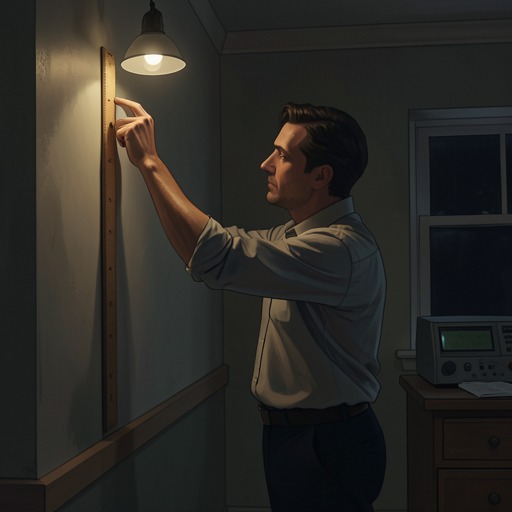
That morning the immediate need is water. Scott finds the thimble he uses as a vessel empty; water on the floor has either dried or drained into holes in the cement, so he will have to descend the thread to another thimble beneath the tank. Before turning toward the water pump, he remembers the pin he needs, searches for it, and cannot find it. In this setting, the ruler is one more object within a difficult landscape, and measuring has become an act Scott can refuse. He calculates three-sevenths of an inch, then deliberately pushes the ruler over until it clatters onto its side. He is sick of measuring himself. The gesture does not challenge the rule or stop its operation; it rejects the repeated act of making his diminishment visible as a number.
Certainty, Despair, and Persistence
The rule’s greatest psychological pressure comes from its reliability. Scott asks himself why he continues exerting himself when, in his estimation, only days remain. He recognizes that his actions seem illogical if everything will soon be over, yet also notices that he cannot simply stop. His doubt about the approaching end is difficult to reconcile with the process’s unbroken record: it has never once faltered. Thinking about that certainty leaves him weaker and less confident, and he fears that dwelling on it could finish him.
His response is to turn away from the calculation and return to work, deliberately ignoring his growing hopelessness. That choice makes the rule a measure of conflict as well as a rate of change: the body’s regular descent presses toward resignation, while Scott continues acting without evidence that action can reverse it. The later act of overturning the ruler brings the same conflict into physical form. He cannot alter the fraction by refusing to look at it, but he can interrupt the ritual of measurement. The rule thus structures the countdown while leaving unresolved the difference between accepting a numerical fact and surrendering to what Scott believes it means.